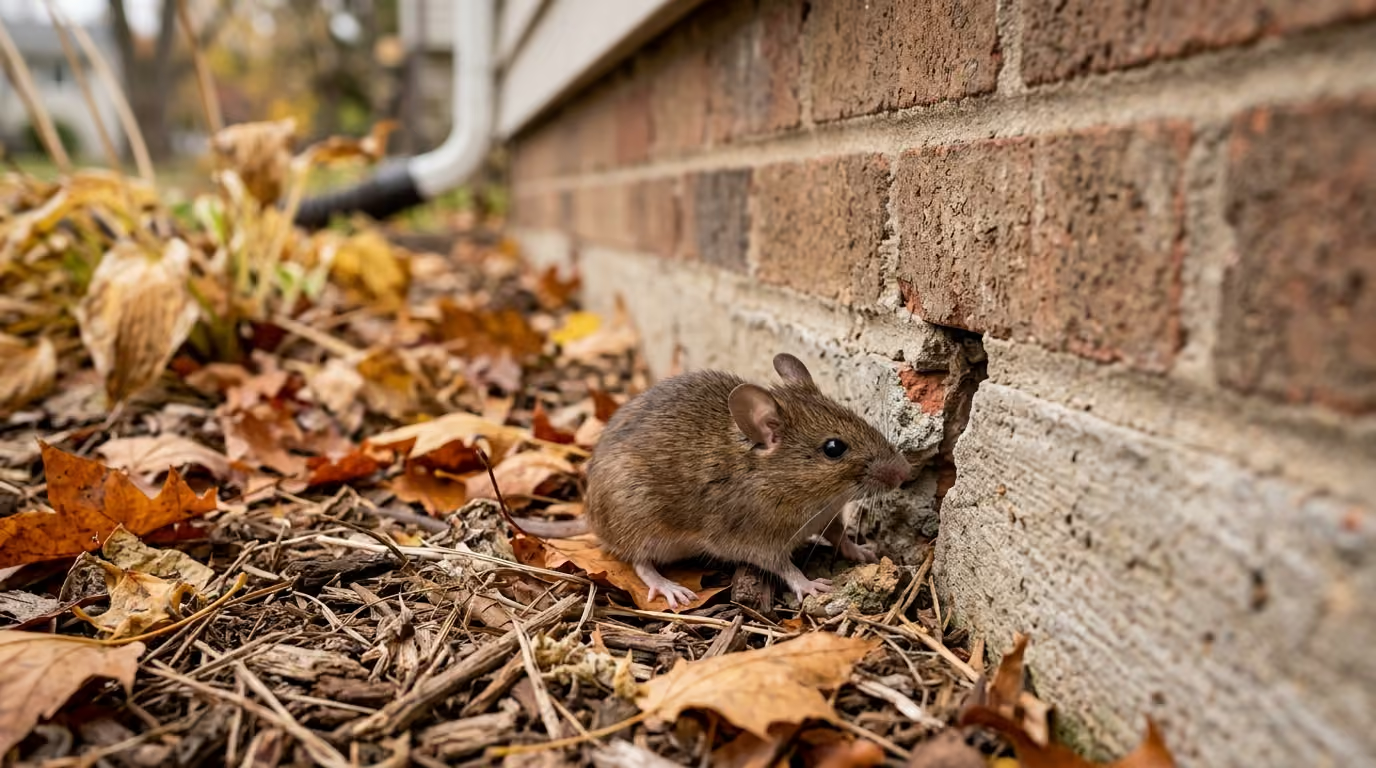
Why Mice and Rats Move Into Fuquay-Varina Homes Every Fall

October is the month that mice and rats stop hesitating. Through the warmer months, rodents stay busy outdoors where food is plentiful and temperatures are comfortable. Once nights start cooling in Fuquay-Varina, that calculation flips fast. They start looking for somewhere warm to spend the winter, and your house is exactly what they have in mind.
The good news is that fall is also the best time to get ahead of the problem. Once rodents are established inside a wall void, crawlspace, or attic, removal takes longer and costs more. Understanding why rodents move indoors in the fall, what draws them to specific homes, and what you can do about it now is the difference between catching the problem early and dealing with a large infestation by January.
Why Fall Migration Happens Earlier Than Most Homeowners Expect
Most people connect rodent problems with winter, which is accurate but a little late. Mice and rats don't wait for the first frost. They start scouting for shelter well before temperatures drop to the point of discomfort, often in early to mid-October in the Fuquay-Varina area. By the time you start noticing signs in your home, a family of rodents has usually been there for a few weeks.
Norway rats are especially deliberate about scouting. They follow the same paths repeatedly and establish runs along foundation walls, under decks, and near crawlspace vents. House mice are less methodical but faster to reproduce, so even a few mice getting inside can lead to a larger population within weeks. Both species are motivated by the same three things: warmth, water, and consistent food access. A home that provides any one of those has already made itself appealing.
Homes near wooded lots or agricultural fields tend to see pressure earlier in the season because rodent populations are already living nearby before cooler weather pushes them indoors.
What Draws Rodents to Some Homes More Than Others
Rodents don't pick randomly. They follow scent trails, test structural gaps, and gravitate toward specific features that make a home easier to enter and more hospitable once inside.
Entry Points
Gaps around utility penetrations are among the most common entry points we find during inspections. Where plumbing pipes, electrical conduits, and HVAC lines pass through the foundation or siding, the surrounding material often gaps or cracks over time. A mouse can squeeze through an opening roughly the diameter of a dime. Rats only need a quarter-sized gap. Those openings are nearly invisible to a homeowner walking around the exterior but obvious to a rodent sniffing along the base of the wall.
Crawlspaces
Crawlspaces with damaged or missing vent screens are another frequent entry point, particularly in Fuquay-Varina homes built before the mid-1990s. Once inside the crawlspace, rodents have direct access to wall voids, insulation, and in some cases, the living areas above. Homes with aging crawlspace vents are worth checking before the worst of fall arrives.
Food Sources
Food access matters too. Bird feeders close to the house, dog food stored in the garage, and even compost bins near the foundation all register as food sources. Rodents are patient and persistent, and a reliable food supply nearby is often what tips a home from "scouted" to "settled."
Signs Rodents Have Already Moved In
Catching rodent activity early is much easier than dealing with an established infestation, so knowing what to look for in October matters. The most common early indicators our team sees in Fuquay-Varina homes include:
- Droppings along baseboards, inside cabinet corners, or near the water heater
- Gnaw marks on food packaging, wooden trim, or wire insulation
- Grease smears along the edges of walls and baseboards where rodents travel repeatedly
- Scratching or rustling sounds in walls or ceilings, often at night
- Nesting material like shredded insulation, paper, or fabric tucked into a corner
Finding one of these signs doesn't always mean a large infestation, but it does mean rodents have already found a way in. Waiting to confirm a "real problem" usually just means waiting for the population to grow. If you're seeing any of these signs in your home, that is worth acting on now rather than in December.
What Professional Rodent Control Does That DIY Doesn't
Snap traps and bait stations available at hardware stores can reduce activity, but they don't address why the rodents moved in or where they're coming from. That's where professional treatment makes all the difference.
At Pest & Termite Consultants, rodent control is included as part of recurring service. When we inspect a home for rodents, we're tracing entry points, checking pressure areas like crawlspace vents and utility gaps, and identifying what's drawing rodents to the property in the first place. Exclusion work, sealing those gaps with materials rodents can't chew through, is what creates a lasting result instead of a recurring problem.
Traps alone without exclusion tend to produce a cycle: activity drops temporarily, then returns with the next wave of seasonal pressure. If you've dealt with mice or rats two or three falls in a row, that pattern usually means the structural openings haven't been addressed. Our customers often find that one thorough inspection early in the season resolves something that's bothered them for years.
If you'd like us to take a look at your home before winter sets in, contact Pest & Termite Consultants to schedule an inspection. We serve Fuquay-Varina, Holly Springs, Angier, Willow Spring, and the surrounding communities.
Mouse & Rat Control FAQs in Fuquay-Varina
How do I know if I have mice or rats?
Droppings are usually the clearest tell. Mouse droppings are small, roughly the size of a grain of rice, with pointed ends. Rat droppings are larger, about the size of a raisin, and more cylindrical. If you're unsure what you’re dealing with, one of our technicians can confirm which rodent species is present during an inspection.
Can rodents get into a home without obvious entry points?
Yes, easily. Entry points are often small gaps that develop over time as a home settles, particularly around utility penetrations, crawlspace vents, and where siding meets the foundation. A home can look fine from the outside and still have several openings that mice or rats would use without hesitation.
How fast can a rodent population grow indoors?
House mice reproduce quickly. A single female can produce five to ten litters per year with up to a dozen offspring each. A small group of rodents entering in October can become a much larger problem by late winter if nothing is done. That's one reason early fall is the most valuable time to act.
Are rodent bait stations safe around children and pets?
Professional bait stations are designed with tamper-resistant housings that prevent access by children and most pets. The placement also matters. Our technicians position stations in areas with confirmed rodent activity and away from pet feeding or play areas. We can walk you through placement specifics when we inspect your home so you understand exactly where everything is set and why.
How long does it take to get rid of mice once treatment starts?
It depends on how established the population is and whether exclusion work is done at the same time. In homes where sealing entry points and trapping or baiting is done together, activity usually drops noticeably within two to three weeks. Homes with larger populations or multiple entry points may take longer. Without exclusion, new rodents will continue entering from outside, which is why we treat both the population and the source during our rodent control services in Fuquay-Varina.
Get Reliable Rodent Protection for Your Home
Don't wait for a winter infestation to confirm what you already suspect. If you're in Fuquay-Varina, Holly Springs, Angier, or Willow Spring and you've noticed signs of rodent activity, reach out to our team to get ahead of it while the season is on your side.