Why Rodents Start Entering Coastal Homes in October

October is when mice and rats shift from a background nuisance to an active problem for homes near North Myrtle Beach. The temperatures along the Grand Strand are still mild this time of year, but once nights start cooling, rodents that have been living in wood piles, overgrown lots, and crawlspace edges start looking for somewhere warmer to settle. That search often ends inside your walls, attic, or beneath your floors before you realize anything has changed.
If you've noticed droppings in the back of a cabinet, heard scratching after dark, or found a chewed corner on a cereal box, a rodent colony is already establishing itself in your home. Here's what to know about how rodents move into coastal homes in the fall, and what it takes to keep them out.
Why October Is When the Problem Usually Starts
Mice and rats don't wait for a hard freeze. In the coastal Carolinas, they start moving well before homeowners expect them to. The combination of shortening days, dropping overnight temperatures, and maturing litters from summer breeding pushes rodent populations outward. Young mice from late-summer litters are dispersing and looking for territory this time of year, which means more individual rodents searching for entry points at the same time.
Homes near water, marsh edges, or undeveloped lots in North Myrtle Beach and the surrounding coastal SC communities tend to see this earlier than neighborhoods farther inland. The habitat edge effect is real: the closer a home sits to natural cover, the shorter the distance a rodent has to travel. Crawlspace foundations common in this region also give mice and rats a protected entry point that's easier to access than a slab home built tight to grade.
Where Rodents Get In and Why It's Hard to Spot
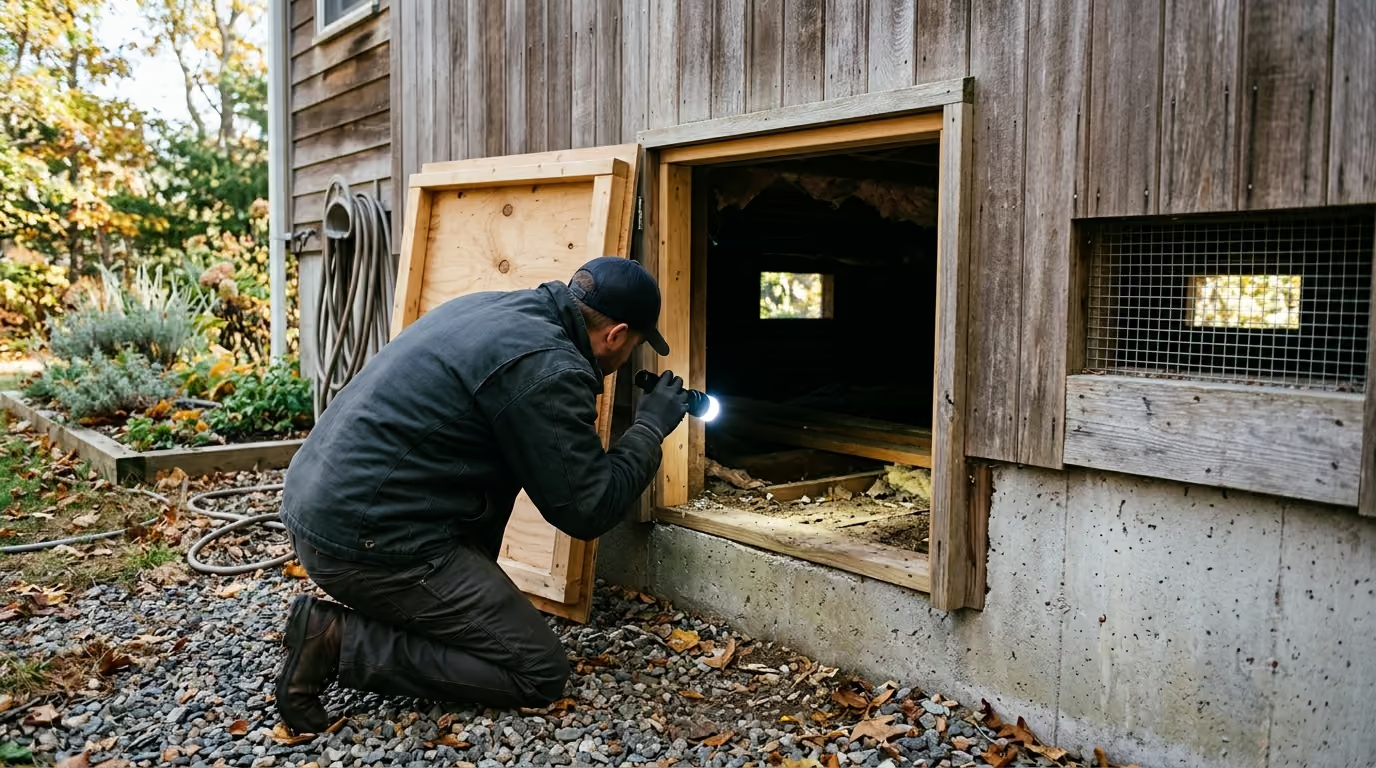
A mouse can squeeze through an opening the size of a dime. That sounds impossibly small, but it describes the gaps that commonly form around aging pipe penetrations, where the fascia board has pulled slightly from the roofline, or the corners of crawlspace vent screens that have corroded through. These aren't construction oversights. They're just normal wear on a house that's been through several years of coastal humidity and heat cycles.
Common entry points we find in North Myrtle Beach area homes include:
- Gaps where utility lines enter the foundation
- Crawlspace vent screens with corroded mesh
- Doors that no longer seal flush at the bottom corners
- The gap between the top of the foundation wall and the sill plate
Rats, which are larger and more powerful than mice, can chew through deteriorating wood or foam insulation to widen existing gaps, so a small opening that kept them out last year may not hold this fall.
Older homes have usually accumulated more wear around foundations and soffit lines, creating more potential rodent entry points. That's not a reason to panic, but it is a reason to take the inspection step seriously before the problem is confirmed by scratching sounds at 2 a.m.
Signs You Already Have a Rodent Problem
Rodents are nocturnal and cautious, so what you see usually understates how active they are. A few droppings near the pantry or under the sink might represent one mouse exploring, or it might represent a family that's been living in the wall cavity for three weeks. The droppings alone don't tell you much about scale, which is part of why getting a professional rodent inspection early makes a difference.
Gnaw marks along cabinet corners or baseboards, grease smears along walls where fur has rubbed repeatedly, and torn insulation in the attic or crawlspace are all signs of repeated activity rather than a single intruder. A musty, ammonia-like smell in a confined area, like a closet, a crawlspace hatch, or the space under a bath cabinet, usually means urine accumulation, which suggests the problem has been going on for a while undetected.
If you're seeing or smelling any of these warning signs, reach out to our team rather than waiting to see if it resolves on its own. It won't.
What Effective Rodent Control Along the Grand Strand Involves
Store-bought snap traps and bait stations can catch a few rodents, but they don't address how or why the rodents got inside. A gap that let one mouse in will let five more in next week. Effective rodent control near North Myrtle Beach starts with finding and sealing the entry points they are using, which requires a thorough inspection of the foundation, crawlspace perimeter, and roofline, not just the areas inside where the activity was noticed.
Our rodent control process for coastal SC homes combines exclusion work with targeted population reduction inside. We look at the structure first to understand how the rodents are getting in, then we address the indoor population. During a follow-up visit, we confirm the exclusion points are holding. That sequence matters. Treating inside without sealing the exterior means you're in a cycle of chasing new rodents out indefinitely.
For properties near North Myrtle Beach, Little River, and Cherry Grove, where seasonal rental use or extended vacancy is common, we also recommend monitoring checks that can catch new activity before it becomes a bigger problem. Empty houses that sit unmonitored through the fall are at higher risk of rodent entry and are more likely to experience significant rodent damage.
Fall Rodent Control FAQs in North Myrtle Beach
How do I know if I have mice or rats?
Droppings are usually the clearest indicator. Mouse droppings are small, roughly the size of a grain of rice, with pointed ends. Rat droppings are much larger, closer to the size of an olive pit, and blunt at both ends. The size of gnaw marks and the entry points you find can also be helpful clues. Deep gnaw marks or a hole that's been enlarged to roughly a quarter-inch diameter through chewing typically point to rats rather than mice.
Can mice cause serious damage to a home?
Yes. Beyond the obvious food contamination and the health concerns associated with droppings and urine, mice are known to chew through wiring, insulation, and even PVC pipe. Rodent-chewed wiring is a contributing factor in residential fires. That's the risk that makes early intervention worth taking seriously rather than waiting the situation out.
Is one mouse sighting a big deal?
Oftentimes, yes. Mice are rarely solitary inside a home. If you see one during the day, it usually means the population has grown to the point where less dominant individuals are being pushed out during daylight hours to forage. A single nighttime sighting is less conclusive, but still warrants checking for entry points and other signs of rodent activity.
Will rodents leave on their own once the weather warms up in spring?
Some may shift back outdoors, but by that point, a rodent colony that moved in during October has had months to reproduce and get settled. Mice can breed year-round indoors. Waiting for spring means you're dealing with a much larger population than you started with, and damage to insulation or wiring has continued the whole time.
How soon after calling do you typically respond in the North Myrtle Beach area?
Response times vary by schedule, but fall is an active season for rodent calls, and early scheduling works in your favor. You can contact us online or give us a call to check current availability and get an inspection scheduled before the problem grows.
Keep Mice and Rats Out of Your Home This Fall
Rodents in coastal homes are a fall fixture, but they're not something you have to accept as normal. The sooner the entry points around your home are found and sealed, the less damage you’ll be dealing with by the time winter is over. Our team covers North Myrtle Beach, Little River, Cherry Grove, Shallotte, Calabash, and communities throughout the Grand Strand. If you're seeing signs of rodents, don't put it off. Get in touch with Pest & Termite Consultants, and we'll take it from there.